




Prof. Yin Haitao on CGTN: China’s Green Energy Transition as an Anchor for Global Economic Stability 2026-04-10
Recently, Prof. Yin Haitao, Executive Dean of the ESG Research Institute at Antai College of Economics and Management (ACEM), Shanghai Jiao Tong University (SJTU), gave an in-depth interview to CGTN (China Global Television Network). During the interview, he shared valuable insights on the global economic impacts of the ongoing Middle East situation, the strategic value of China’s new energy development, and supply chain resilience.
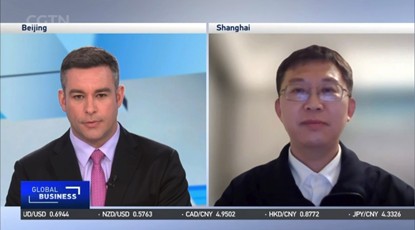

CGTN: The Middle East conflict is driving up prices not only for oil, but for key industrial inputs such as aluminum and lithium, intensifying inflation and supply chain stress worldwide. China has spent years investing heavily in new energy infrastructure. How successfully have these investments cushioned global consumers from energy price volatility?
Prof. Yin: In this crisis, China has successfully stabilized its domestic energy prices — which is not only good news for the Chinese people, but a meaningful contribution to global consumers as well. China's decades-long investment in new energy development has yielded an energy system that is cleaner, more affordable, and critically, more resilient.
By the end of 2025, China's installed capacity of wind and solar power had reached 1.8 billion kilowatts, accounting for roughly 47 percent of the country's total electricity generation capacity. In terms of cost, the levelized cost of electricity (LCOE) for wind and solar has now fallen below 0.2 yuan per kilowatt-hour — far cheaper than coal, which had long been the primary source of power generation in China.
For many industrial sectors — aluminum and lithium processing, among them — electricity costs play a defining role in the overall cost structure. China's cheap and stable electricity prices serve as a direct counterweight to the inflationary pressures triggered by rising oil prices during this crisis.
I should also highlight the contribution of China's booming electric vehicle industry. With EVs now accounting for more than 50 percent of new car sales, China has significantly reduced its dependence on oil. And the large-scale export of affordable EVs is helping consumers in other countries accelerate their transition away from oil-dependent transportation — broadening the buffer against global oil price shocks well beyond China's own borders.
CGTN: China's manufacturing supply chain has proven relatively resilient in the face of disruptions around the Strait of Hormuz. How can China leverage this stability to strengthen its already formidable position as the world's manufacturing hub?
Prof. Yin: China is, and will continue to be, a vital stabilizer for the global supply chain — and I say that for three reasons.
First, China contributes approximately one-third of global manufacturing output, making it an irreplaceable node in international supply networks. Second, as I mentioned, China has established a cleaner, cheaper, and more resilient energy system. With its firm commitment to building out renewable electricity capacity and a highly efficient transportation infrastructure, production and logistics costs in China will remain competitive for the long term. Third, China has built a consistent track record of adhering to the norms and conventions of global commerce.
Taken together, these three factors give me confidence that China will serve as a reliable anchor for the global supply chain for years to come.


Prof. Yin’s remarks reveal the deeper logic shaping the current global economic landscape. Amid rising geopolitical tensions that are restructuring the global energy and trade order, China’s green energy transition demonstrates strategic value far beyond its domestic market, emerging as a structural stabilizing force in a volatile global environment.